2026-02-04
Why Forehead Lift, Not Double Eyelid Revision, Was the Priority | Endotine Endoscopic Forehead Lift Real Case at SH Plastic Surgery
A 51-year-old woman's case where a 15-year-old buried double eyelid line became covered, with eyelid sagging and undereye puffiness/hollowness. This complex surgery involved sub-brow lift and epicanthoplasty to correct the upper face, and lower blepharoplasty with midface lift to address fundamental sagging, going beyond simple fat repositioning.
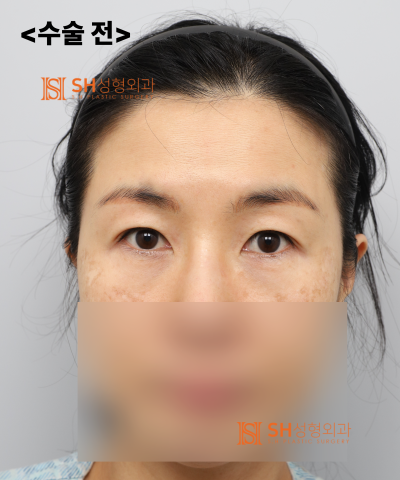
This is a real case of a 51-year-old woman who, after undergoing buried double eyelid surgery 15 years ago, entered her 50s with her double eyelid line covered, accompanied by eyelid sagging and simultaneous undereye puffiness and hollowness. This complex surgery involved correcting the upper facial structure first with a sub-brow lift and epicanthoplasty instead of incisional double eyelid surgery, and going beyond the limitations of simple undereye fat repositioning by combining lower blepharoplasty with a midface lift to fundamentally improve sagging. We structurally explain 50s buried double eyelid revision, the difference between sub-brow lift and upper blepharoplasty, and why lower blepharoplasty and midface lift are necessary, with accompanying photos.<
Hello. I'm Dr. Kim Sung-hoon, director of SH Plastic Surgery, a facial designer.
‘My double eyelids seem to have come undone.’<
This is the most common phrase I hear in consultations after the age of 50.
However, upon diagnosis, the problem is often not the double eyelid line itself,
but rather the upper facial and undereye structures that cover that line.
The case I'm introducing today is also not about ‘revision surgery’,
but about a patient for whom surgery to rebuild the structure was the priority.
CASE
Female, born in 1975 / 51 years old
Buried double eyelid surgery around age 35 (approx. 15 years ago)
Main concerns
Covered double eyelid line
Eyelid sagging
Undereye fat puffiness and hollowness
Overall dull-looking impression
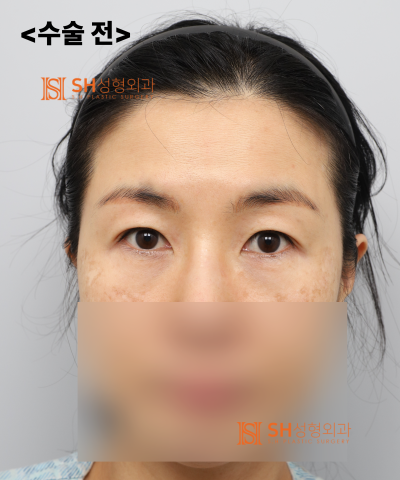
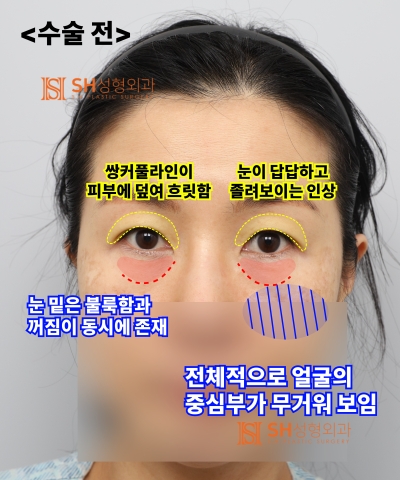
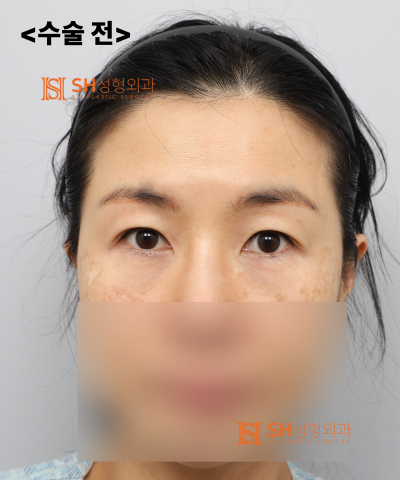
Pre-surgery condition analysis
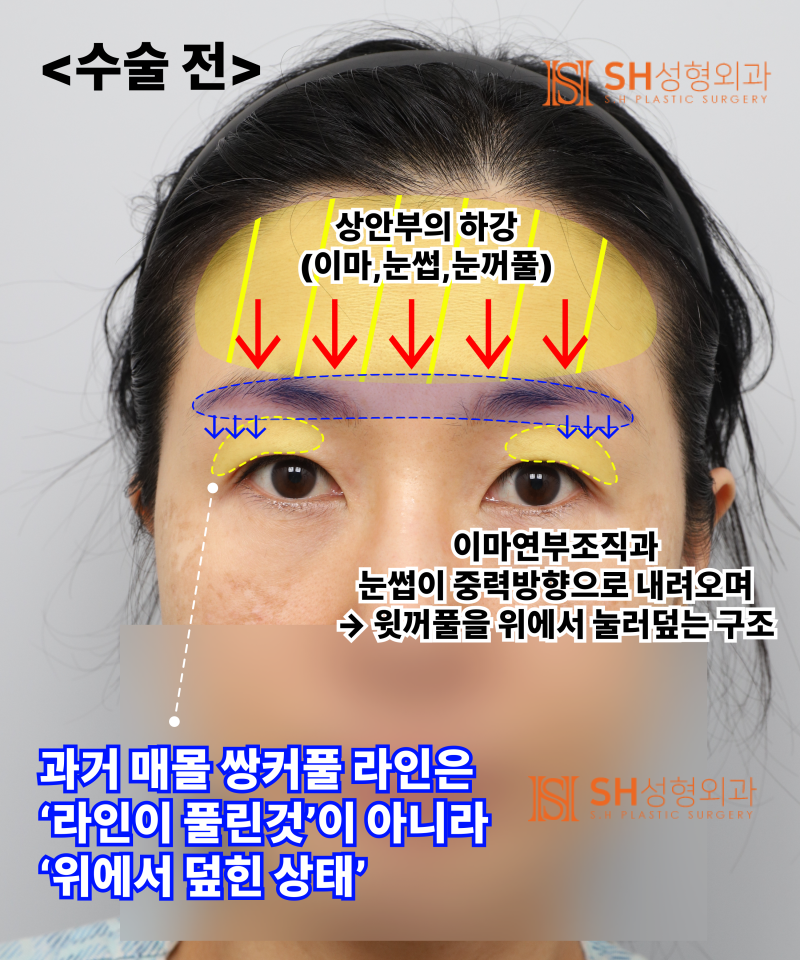
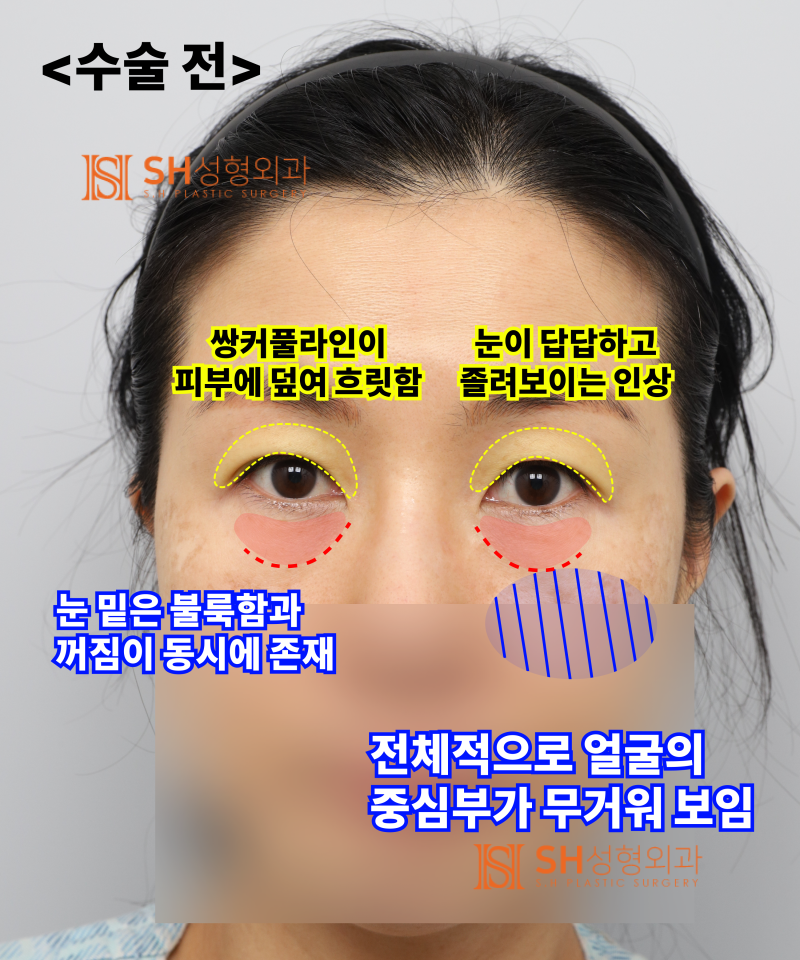
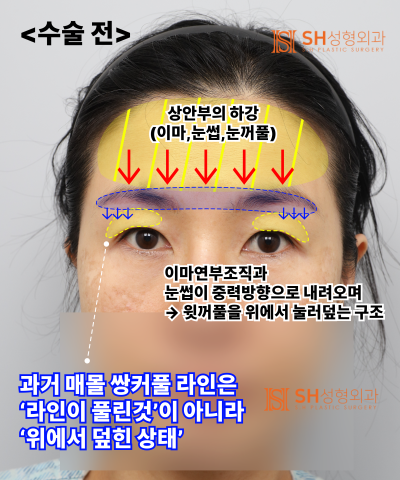
The buried double eyelid line from 15 years ago appears covered due to upper facial sagging.
It's not that the eyelid skin is stretched,
but a structure lacking the functional allowance to lift with the eye when opened.
Upper facial descent that cannot be resolved by mere skin excision below the eyebrow.
One side of the undereye is puffy,
and the other side appears hollow, a typical undereye structure for someone in their 50s.
This was a case where incisional double eyelid surgery would likely make the line thicker and the impression heavier.
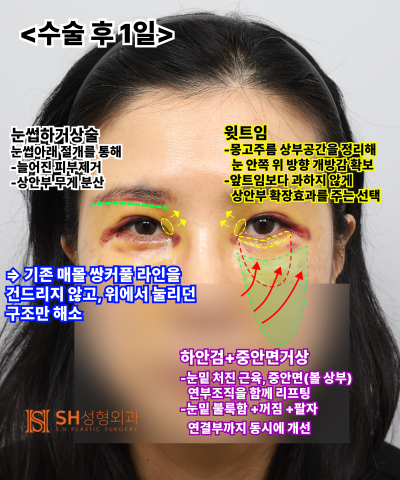
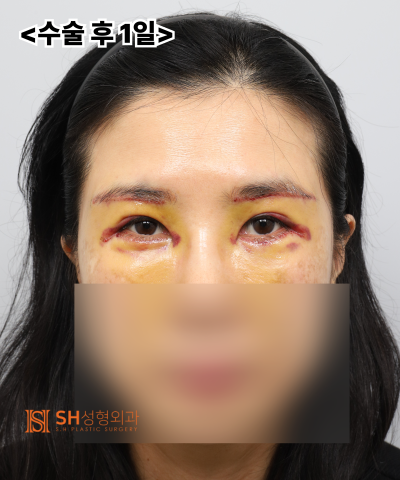
1 day post-surgery – Explanation of procedures performed
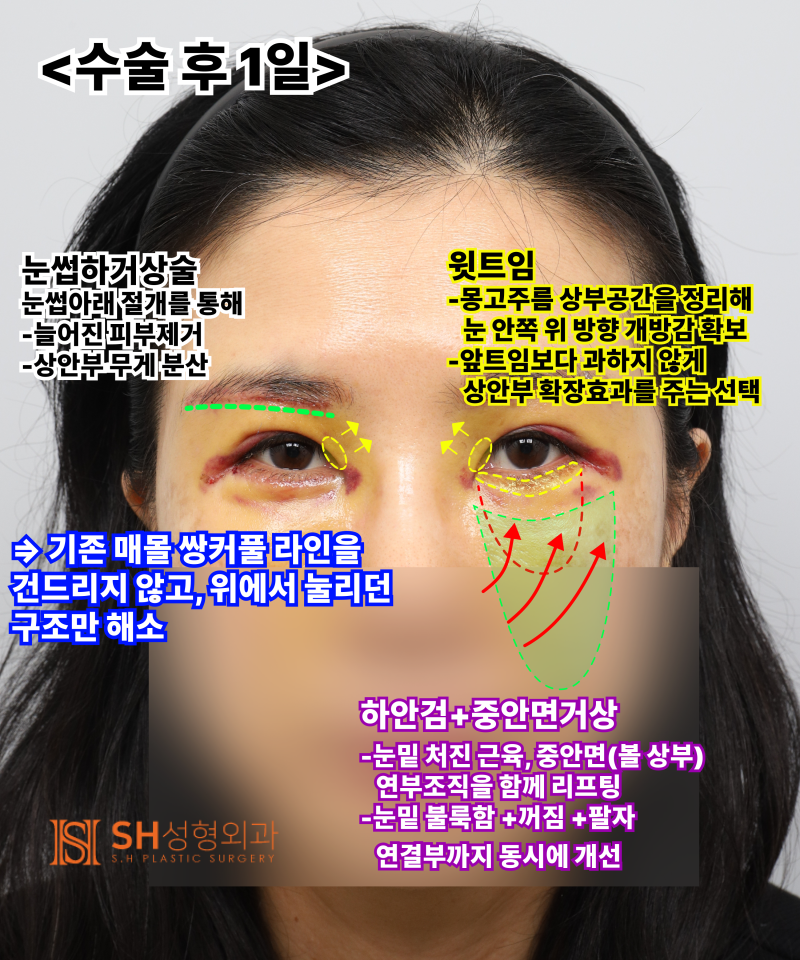
① Sub-brow lift
Trims the sagging skin below the eyebrow
Reduces upper facial weight and improves exposure of the double eyelid
Secures a structure where the line can be revealed without incisional double eyelid surgery
② Epicanthoplasty
Gently alleviates Mongolian folds
Increases upper facial openness with an effect similar to medial epicanthoplasty
③ Lower blepharoplasty + Midface lift
Not just simple fat repositioning,
but a structural lifting that pulls up the undereye muscles and midface together
Simultaneously improves undereye puffiness, hollowness, and cheek sagging
Immediately after surgery, there is swelling and bruising, but the structural changes have already been made.
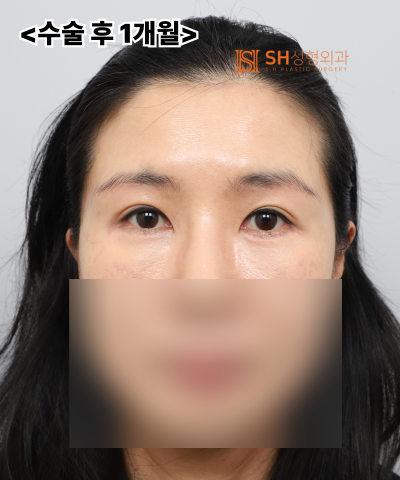
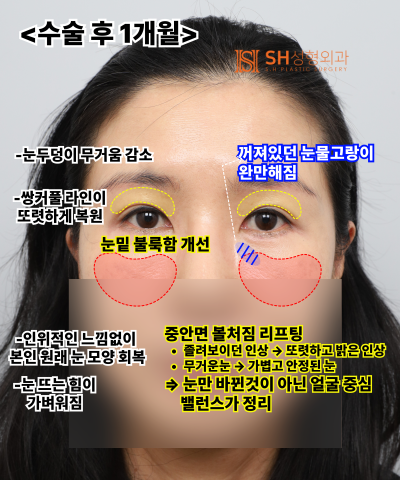
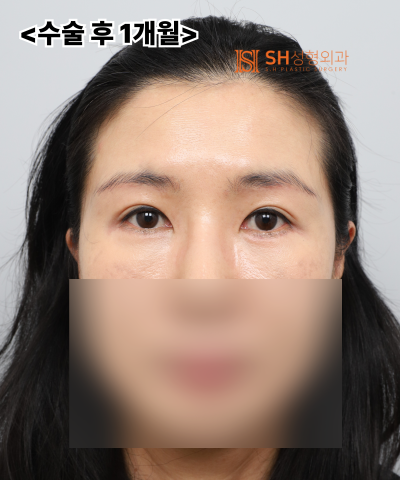
1 month post-surgery
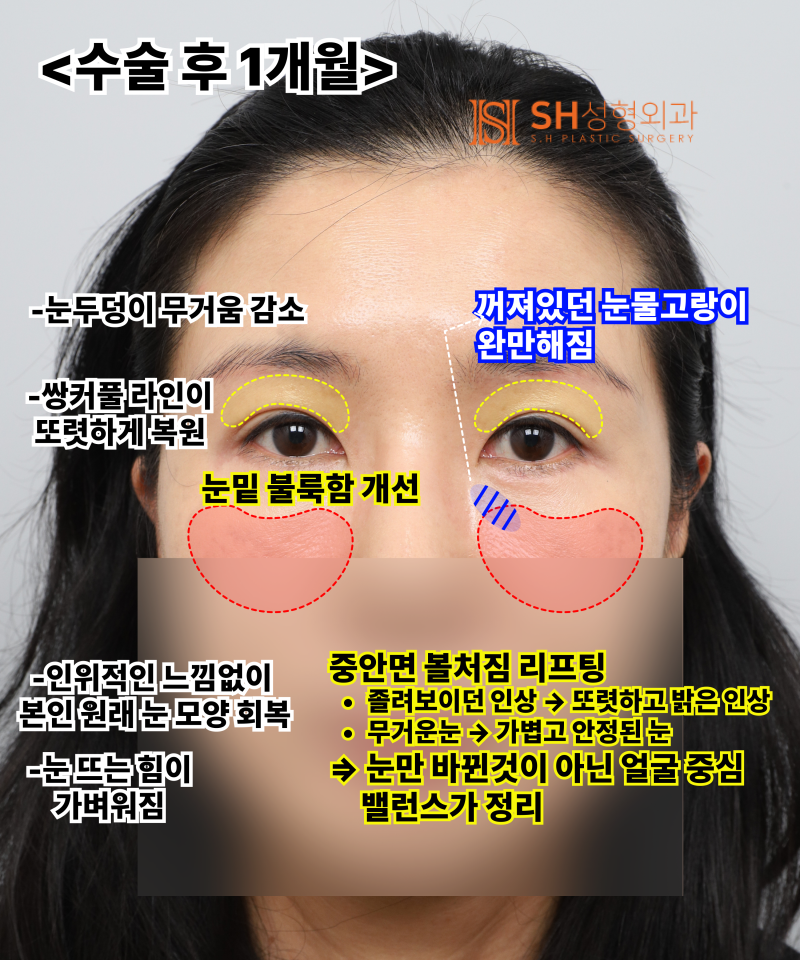
The previously covered double eyelid line is naturally exposed.
Restoration of the distance between the eyebrow and eye → eyes no longer look constricted
Reduced undereye puffiness + midface lift results in a refined facial impression
Without incisional double eyelid surgery,
a light and clear eye shape + overall impression improvement

Why was this surgery necessary?
The core of this case was
not ‘the problem of recreating the double eyelid’,
but ‘the problem of creating a structure where the double eyelid can be revealed’.
Upper facial sagging → Sub-brow lift & Epicanthoplasty
Undereye/cheek sagging → Lower blepharoplasty + Midface lift
Individually, these may seem like minor surgeries,
but when performed together, they yield long-lasting results without the need for revision surgery.
Dr. Kim Sung-hoon's Reflection
Eye surgery after the age of 50 should not be ‘surgery to create a line’
but ‘surgery to correct the structure’.
In cases like this patient's, with a history of buried double eyelid surgery,
if the cause of the disappearing line is not accurately identified, revision surgery will be repeated.
Performing incisional double eyelid surgery when the upper face is pressed down is likely to result in a thick and strong impression.
Sub-brow lift, epicanthoplasty, lower blepharoplasty, and midface lift are surgeries with clear individual purposes,
and when combined according to the structure, the most natural and long-lasting results can be expected.
FAQ
Q1. Is incisional double eyelid surgery really not recommended for people in their 50s?
A. It is not recommended if upper facial sagging is the cause.
Q2. Is the sub-brow lift scar very noticeable?
A. It is designed along the eyebrow line and is hardly noticeable in daily life.
Q3. Can improvement be achieved without buried double eyelid revision?
A. It is entirely possible if the underlying structure is addressed.
Q4. Does epicanthoplasty make the impression sharp?
A. It is performed naturally by expanding only the upper part without overcorrection.
Q5. Can't I just have undereye fat repositioning?
A. After the age of 50, addressing muscle and cheek sagging is also necessary.
Q6. Do lower blepharoplasty and midface lift always have to be done together?
A. If sagging is present, performing them together reduces the risk of recurrence.
Q7. What is the recovery period?
A. Major swelling subsides in 2 weeks, and naturalness is achieved in 1-3 months.
Q8. How long do the results of this surgery last?
A. They are maintained much longer and more stably than simple revision surgery.
SH Plastic Surgery Clinic
Introducing cases of sub-brow lift & forehead lift! You can change too~
※This content is for general medical information purposes only,
and results and recovery processes may vary depending on individual conditions.
Actual treatment and surgical methods are determined after diagnosis by medical staff.