2026-02-11
Why a 51-year-old's droopy eyes were fixed with an Endotine forehead lift instead of incisional double eyelid surgery | Eyebrow lift and lower blepharoplasty combined case at SH Plastic Surgery
This 51-year-old woman, with a history of buried suture double eyelid surgery, had complex upper facial aging. Instead of incisional double eyelid surgery, her droopy eyes were corrected with an Endotine forehead lift, sub-brow lift, epicanthoplasty, and lower blepharoplasty with midface lift, addressing the root causes of her eye sagging.
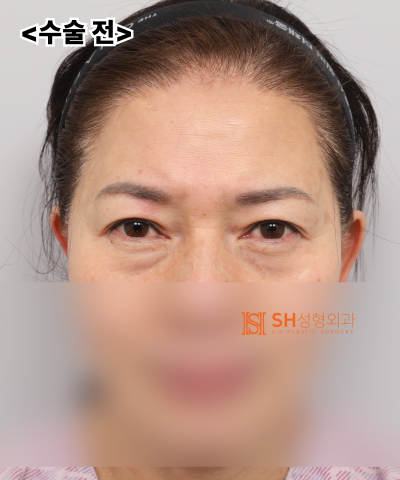
After the age of 50, droopy eyes are not merely a double eyelid issue but a complex aging phenomenon where the forehead, eyebrows, eyelids, and under-eye structures sag together. This case involves a 51-year-old woman with a history of buried suture double eyelid surgery 15 years ago. She presented with a very narrow distance between her eyes and eyebrows, and a typical upper facial sagging structure connected to wrinkles on her forehead, glabella, and nose bridge. Instead of incisional double eyelid surgery, an Endotine forehead lift, sub-brow lift, epicanthoplasty, and lower blepharoplasty with midface lift were performed to address the fundamental cause of her droopy eyes. We will analyze in detail how her eye shape and overall impression changed through her pre-operative, 1-day post-operative, and 1-month post-operative progress. Dr. Kim Sung-hoon, Facial Designer at SH Plastic Surgery.
‘When I try to open my eyes, I keep using my forehead muscles.’‘I used to have double eyelids, but now my eyes look smaller.’
These were the first words spoken by a 51-year-old female patient, who had undergone buried suture double eyelid surgery 15 years prior, in the consultation room.
The surgery she had hoped would make her eyes clearer had, over time, resulted in her eyelids covering her eyes even more.
Every time she opened her eyes, she used her forehead and glabella muscles, causing wrinkles to deepen.
This case was not a simple double eyelid problem;
it required a complete redesign of the ‘eye sagging structure’ connecting the forehead, eyebrows, eyelids, and under-eyes.
Patient Information
Age: 51
History: Buried suture double eyelid surgery in her mid-30s (approx. 35 years old)
Main Concerns:
Double eyelid line covered
Droopy eyelids creating a tired impression
Under-eye puffiness accompanied by hollowness
Wrinkles connecting the forehead, glabella, and nose bridge
Desired Outcome:
Natural and clear eye shape rather than ‘large double eyelids’
Avoidance of thick-looking incisional double eyelids
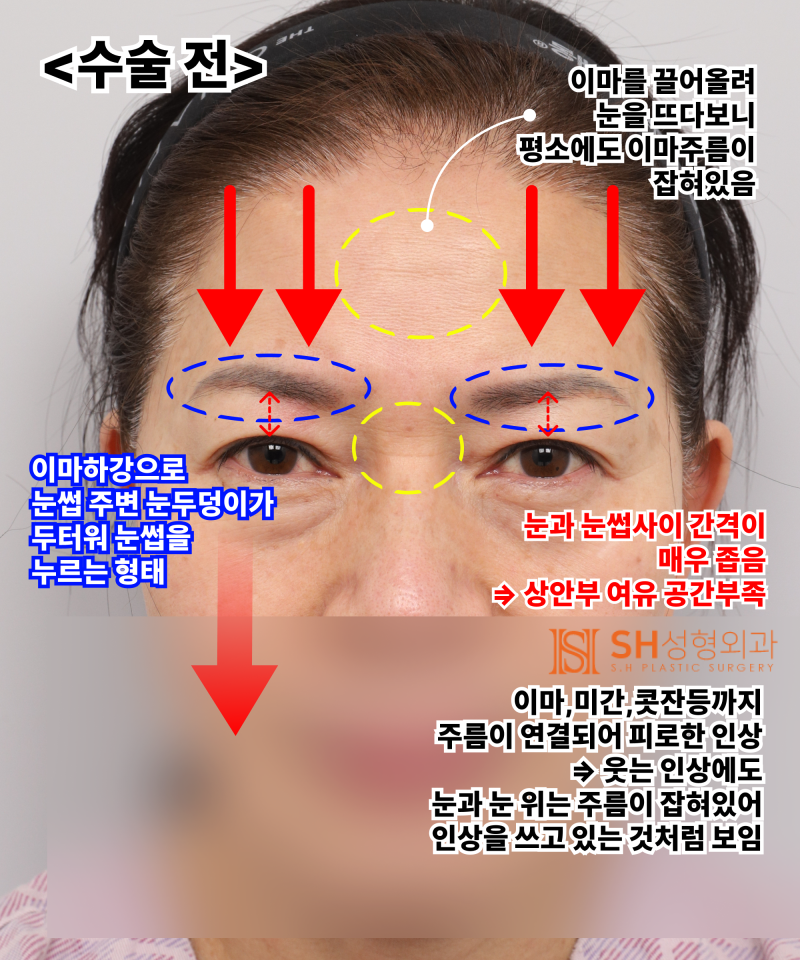
Pre-operative Photo Analysis – What were the problems?
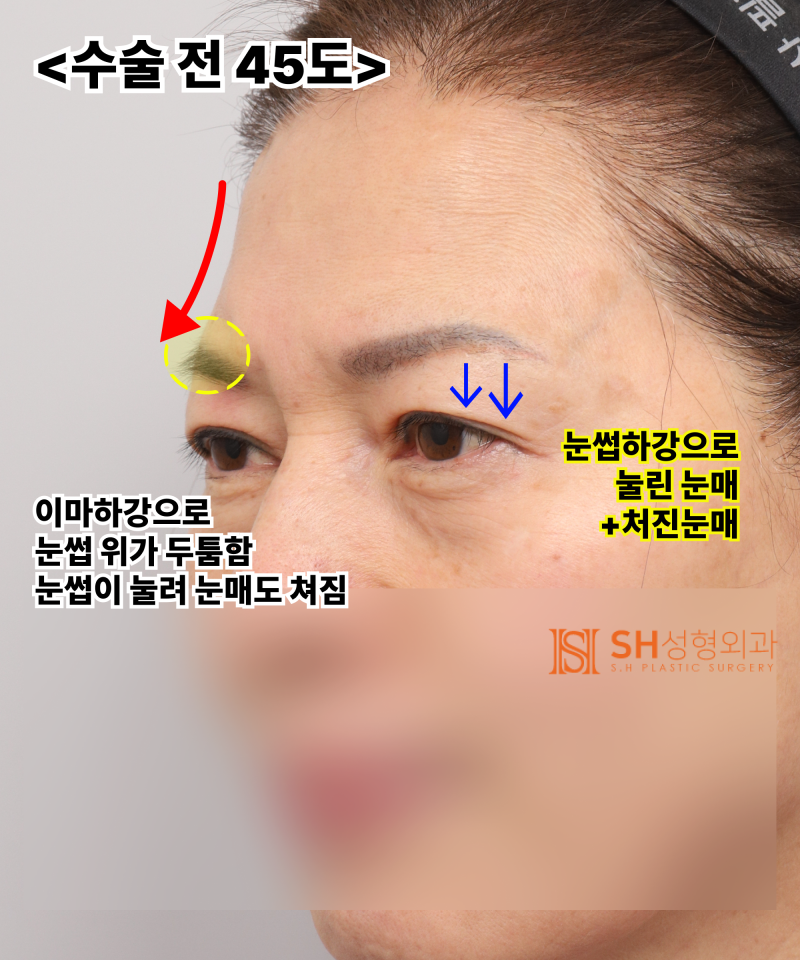
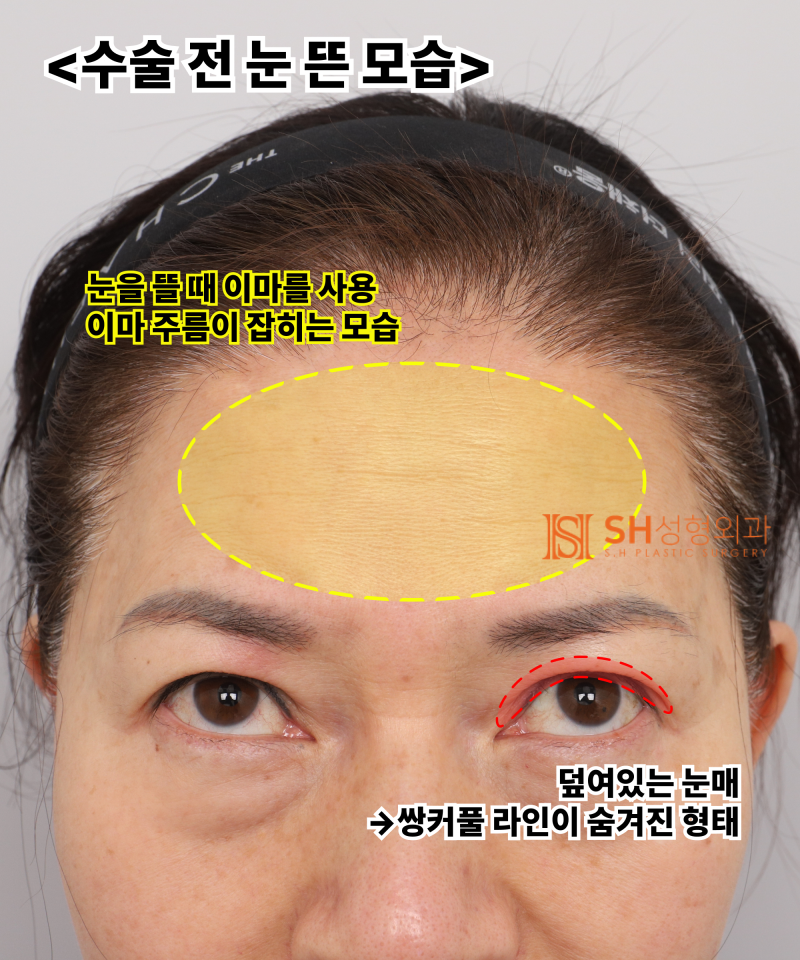
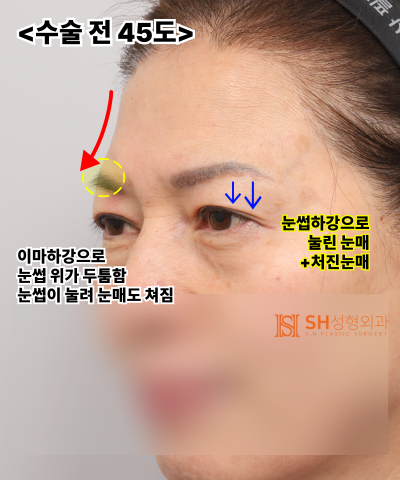
① Insufficient distance between eyes and eyebrows
The eyebrows had descended, pressing down on the eyelids,
completely covering the existing buried suture double eyelid line.
This naturally led to the use of forehead muscles when opening the eyes, resulting in fixed forehead wrinkles.
② Loss of upper facial space
With the narrow space between the eyes and eyebrows, incisional double eyelid surgery
was likely to result in a thick and artificial appearance.
③ Concurrent under-eye structural issues
It wasn't just protruding fat; under-eye puffiness and hollowness connected to midface sagging were observed simultaneously.
Final Surgical Plan – Why was this surgery necessary?
1. Endotine Forehead Lift + Sub-Brow Lift
Addresses the fundamental cause of depressed eyebrows and eyelids due to forehead descent.
Repositions the structure so that forehead muscles are not needed to open the eyes.
Secures upper facial space → restores a natural eye shape.
2. Epicanthoplasty (Upper Canthoplasty)
Gently opens the upper part of the epicanthal fold to improve eye openness.
Replaces traditional canthoplasty, creating a refreshed impression without overcorrection.
3. Lower Blepharoplasty + Midface Lift
Complements the limitations of simple under-eye fat repositioning.
Corrects under-eye puffiness + lifts sagging cheeks.
Improves the lower face, naturally connecting to the nasolabial folds.
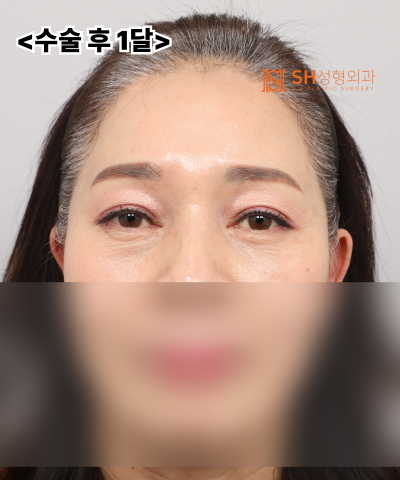
1-Day Post-Operative Progress – What surgery was performed and how?
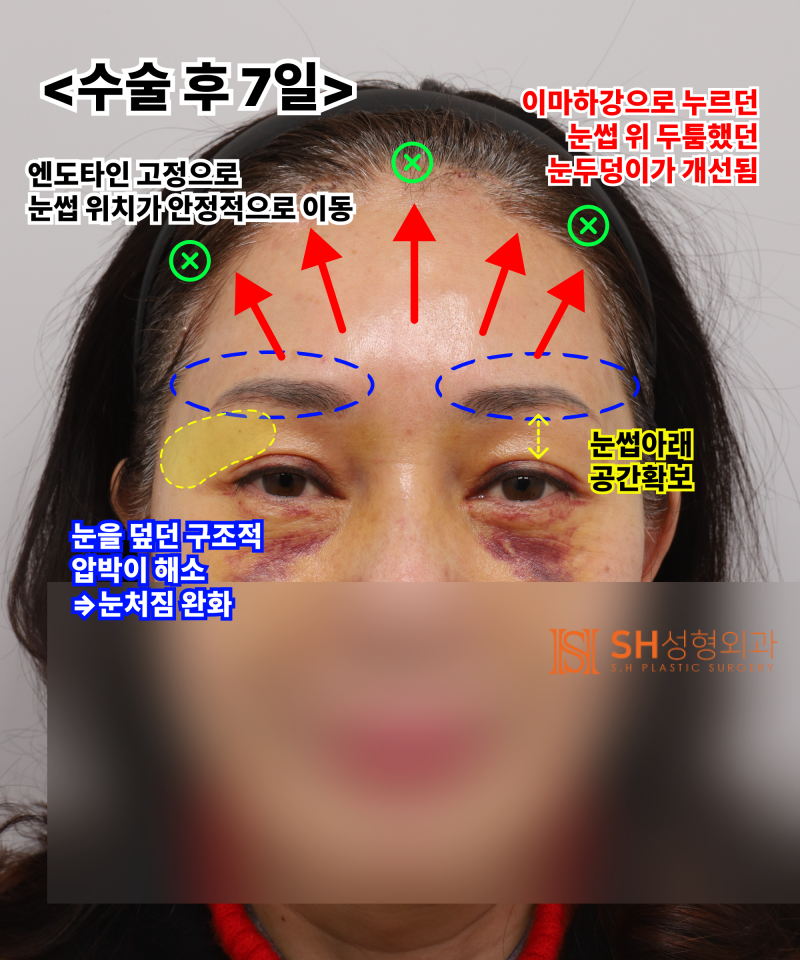
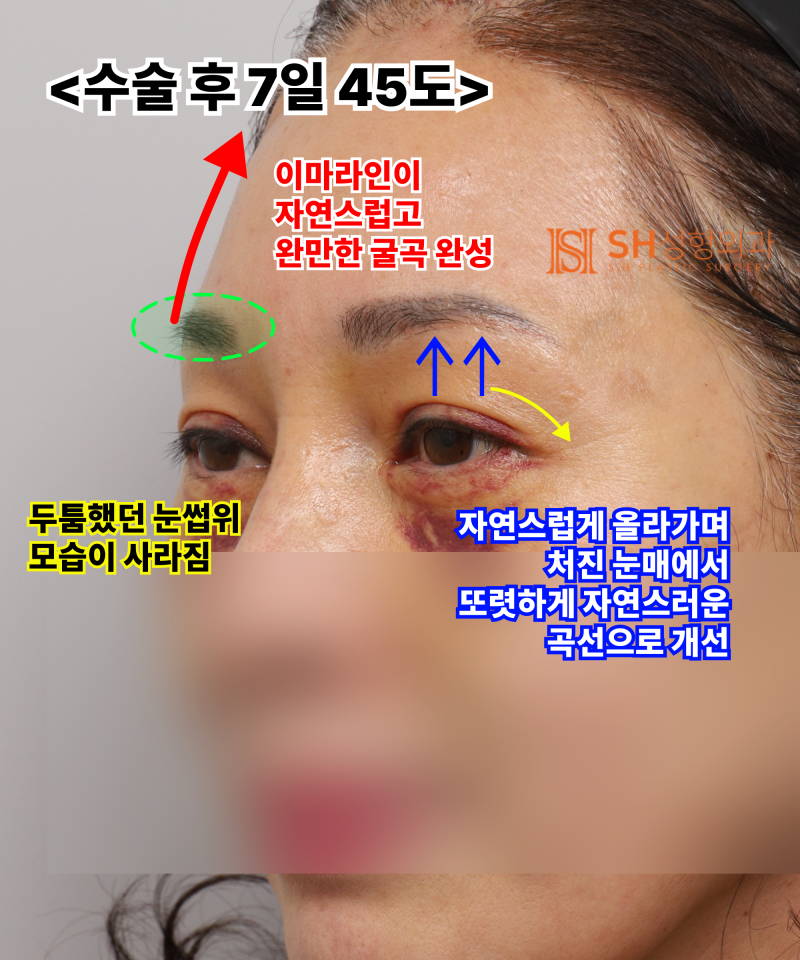
The eyebrow position was stably elevated through Endotine fixation.
The compressive structure of the forehead, eyebrows, and eyelids was resolved, making the eyes feel much more comfortable.
Bruising and swelling were present, but the direction and openness of the eye shape were already visible.
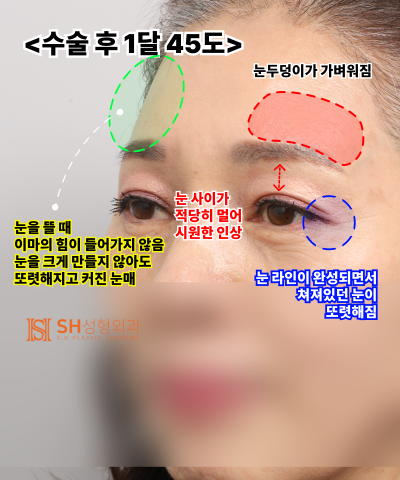
1-Month Post-Operative Progress – What has changed?
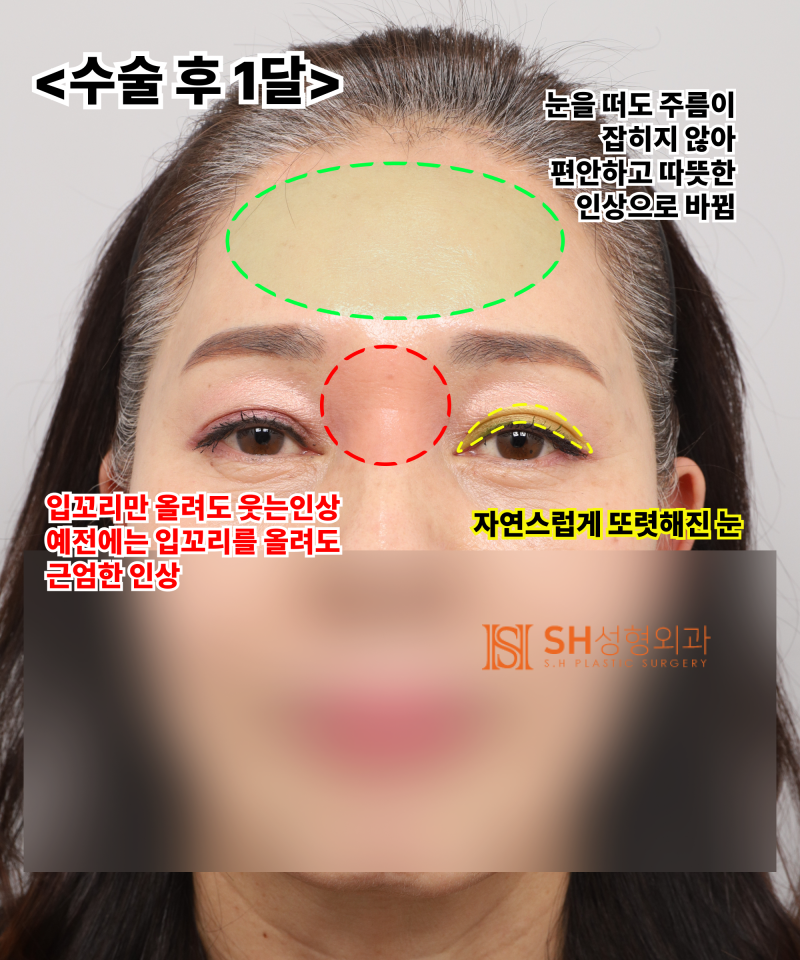
Clearer eye shape without needing to open eyes wide.
The thickness above the eyebrows has disappeared, and the forehead line is naturally defined.
The existing buried suture double eyelid line is revealed naturally and stabilized.
The under-eyes and midface are refined together, making the overall impression brighter and more relaxed.
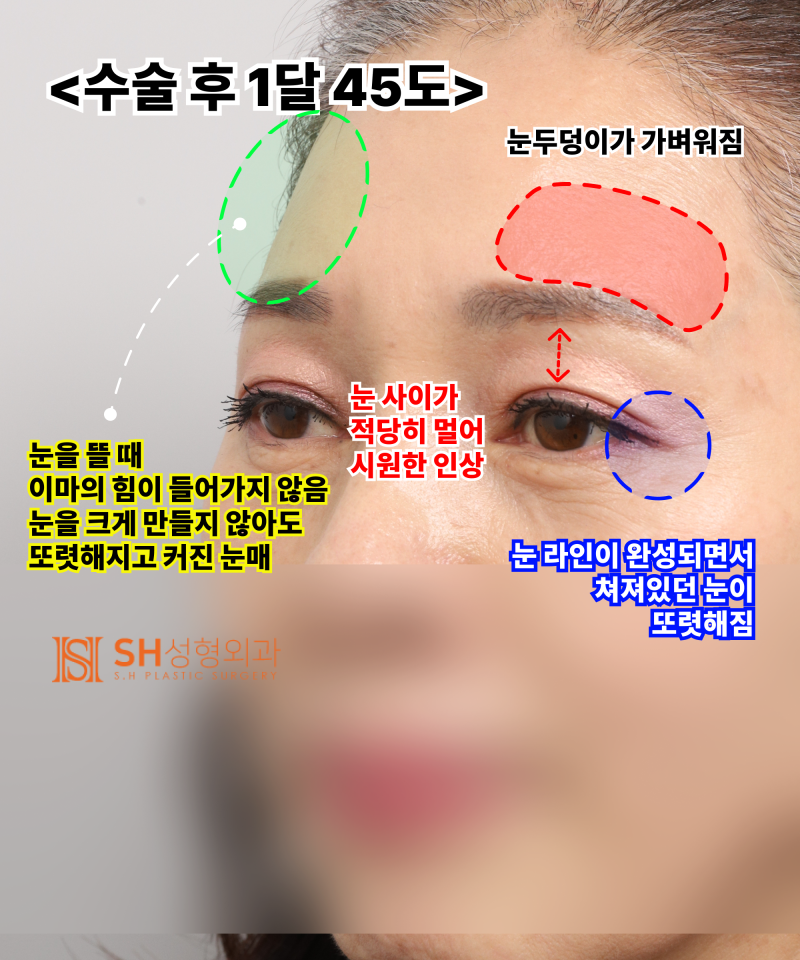
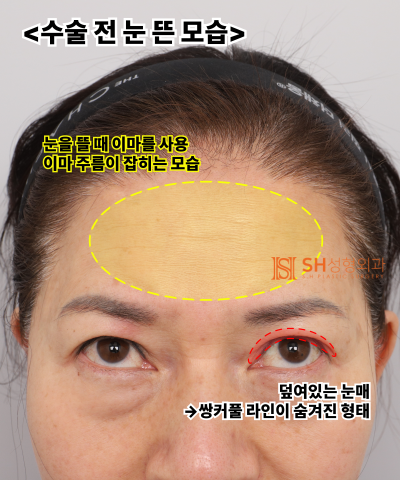
Forehead–Eyebrow Line Change (Key to Upper Facial Structure Improvement)
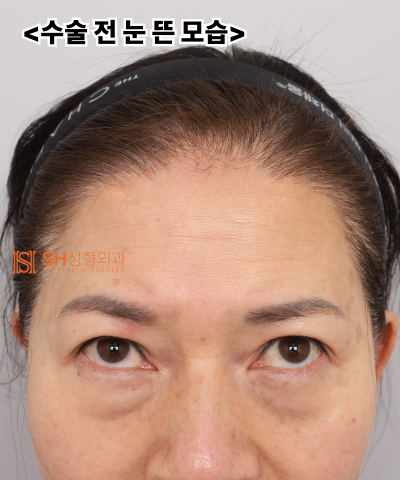
Pre-operative
The lower forehead and eyebrows were generally pressed downwards.
The distance between the eyebrows and eyes (brow–upper eyelid gap) appeared narrow,
and the weight of the forehead muscles was directly transferred to the eyelids,
→ resulting in a tired impression despite the eyes being open.
Post-operative
The lower forehead was repositioned upwards,
and the eyebrow line gently lifted.
Space between the eyebrows and eyes was naturally secured.
→ creating a structure where the field of vision is open without forcing the eyes open.
Point: Rather than ‘eyes becoming bigger,’
the weight pressing down on the eyes was removed.
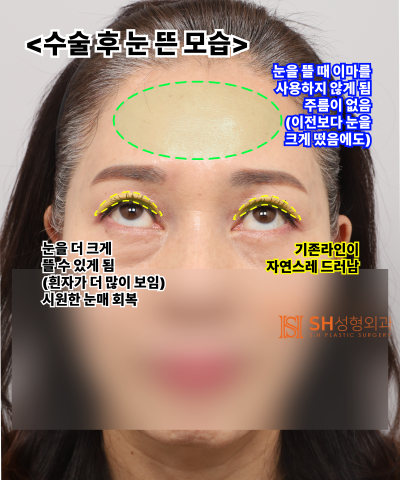
Natural space secured between the eyes and eyebrows.
Less effort required to open the eyes, creating a relaxed impression.
Forehead, glabella, and nose bridge wrinkles alleviated.
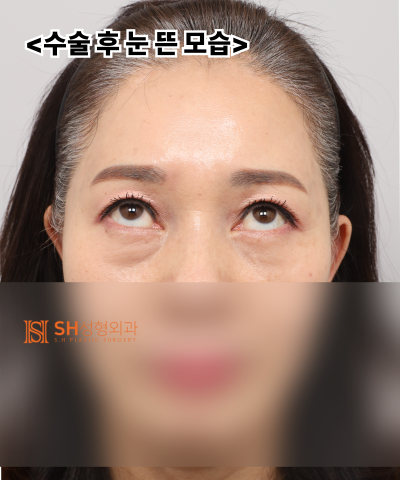
Eye Openness Change (Epicanthoplasty + Upper Facial Lifting Effect)
Pre-operative
The epicanthal fold and upper eyelid skin overlapped,
creating an impression of the inner upper eye being blocked.
A structure where the effect of traditional canthoplasty would be limited.
Post-operative
Epicanthoplasty selectively expanded only the upper inner space.
Without excessive opening,
→ increased exposure range of the pupil.
Eye shape became clearer and more refreshed.
📌 Point:
‘Not a stretched eye look X’
‘A structure where eyes open well O’
Dr. Kim Sung-hoon’s Reflection
After the age of 50, droopy eyes are not just a double eyelid problem.
It is a structural issue where forehead descent, eyebrow position changes, and eyelid skin laxity act simultaneously.
In this case, if incisional double eyelid surgery had been performed,
it could have resulted in a thick and artificial impression, making it a classic example.
The key was to first secure upper facial space through an Endotine forehead lift and sub-brow lift,
and then balance the entire eye area by combining lower blepharoplasty with midface lift for the under-eyes.
This is a case where ‘surgery that redesigns the eye structure’ is needed,
rather than ‘surgery that only focuses on the eyes.’
FAQ Frequently Asked Questions
Q1. Why is incisional double eyelid surgery not recommended for droopy eyes in your 50s?
A. If there is insufficient upper facial space, it can become thick and unnatural.
Q2. In what cases is an Endotine forehead lift suitable?
A. It is effective when the distance between the eyes and eyebrows is narrow and accompanied by forehead wrinkles.
Q3. Does buried suture double eyelid revision surgery always require an incision?
A. No. Depending on the structure, a sub-brow lift or forehead lift may be more suitable.
Q4. Will under-eye problems be resolved with lower blepharoplasty alone?
A. If midface sagging is also present, there are limitations, and combined surgery is necessary.
Q5. Will my impression change excessively after surgery?
A. The goal is not to ‘look younger’ but to achieve a ‘comfortable and natural impression.’
Q6. How long is the recovery period?
A. Significant swelling takes about 2–3 weeks, and natural stabilization takes about 1–3 months.